
Why Trudeau’s Fight to cool Toronto housing is an uphill battle
Photographer: James MacDonald/Bloomberg
Why Trudeau’s Fight to Cool Toronto Housing Is an Uphill Battle
By-
Fundamentals explain only 40% of price gains: CMHC report
-
Wealth inequality and speculation partly driving prices
Justin Trudeau’s Liberal government has been under pressure to rein in runaway home prices, but a study by the national housing agency suggests the prime minister will struggle to exert control over the real estate market in Canada’s largest city.
Duclos commissioned the review in June 2016 and has sought further updates for a final version expected soon that will help shape a new national housing strategy, his spokesman Mathieu Filion said by email. “This is an important report as Minister Duclos has said on many occasions that we are missing important data on housing and all good policies need to be developed with valid data,” Filion said.
Trudeau, who has repeatedly pointed to an affordability crisis in Toronto and Vancouver, gave Duclos marching orders to look into how to fix the problem. The minister’s role will include “undertaking a review of escalating home prices in high-priced housing markets and considering all policy tools that could keep home ownership within reach for more Canadians,” according to Duclos’ mandate letter from the prime minister.
The report backs up Bank of Canada Governor Stephen Poloz’s view that interest rates aren’t the best tool for dealing with potential housing bubbles. CMHC found about three-quarters of Vancouver’s price gains were tied to fundamentals, versus 40 percent in Toronto, suggesting the latter city is an isolated trouble spot, another argument against using monetary policy, which has widespread effects, to bring prices down.
Wealth and income inequality are likely important drivers for the large price moves in higher-priced detached homes, the report said, because industries that cluster in big cities and offer high-paying jobs can feed the prices for the more expensive properties.
The supply side also offered important clues. The stock of housing in Toronto and Vancouver was much less responsive, or what economists call elastic, to rising prices, the report said. “Supply challenges including land supply and zoning regulation emerge as factors that contribute particularly to high priced markets.’’
There are also few signs that builders are in a genuine struggle to keep pace with rising demand, which would typically lead to a surge in provincial construction wage rates.
Uncomfortable Choices
Another possible driver of rising single-family home prices may be that geographical constraints have driven up land prices, encouraging builders to switch development to higher-density options such as condominiums.
CMHC cautioned against making firm conclusions in some of these areas because of a lack of reliable data around trends such as foreign ownership. Most of the report’s conclusions and recommendations were redacted under provisions in the access to information law that exempts advice to ministers. However, the end result is that governments are left with uncomfortable choices, the agency found.
The early draft sent to Duclos in December was released for an academic peer review that’s still underway, CMHC spokesman Jonathan Rotondo said by phone. The Ottawa-based agency insured C$496 billion ($396 billion) of residential loans as of June 30.
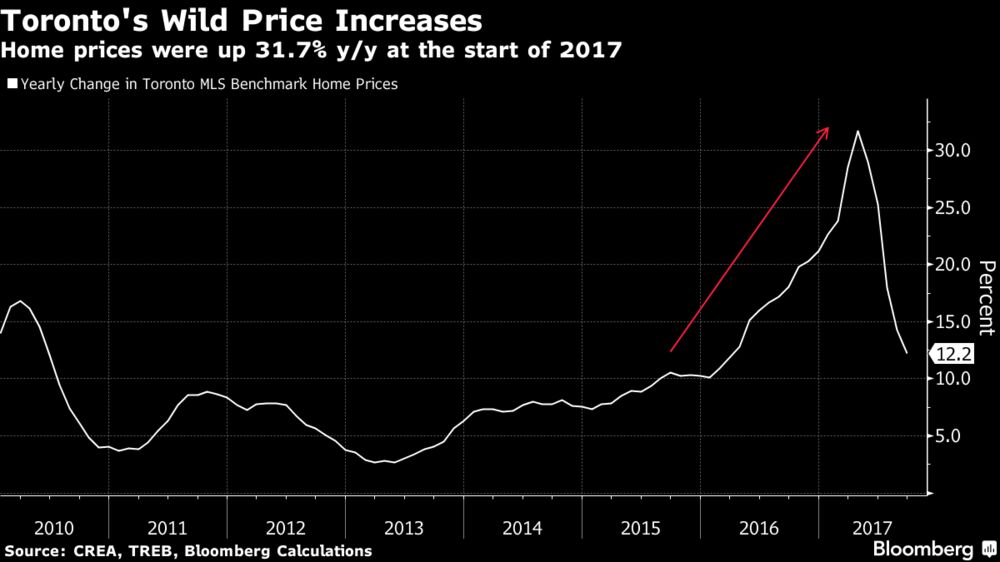
Toronto home prices are already declining by the most since 2000 after the provincial government introduced a foreign buyer tax in April. Benchmark prices are down 8 percent since May. Even with that slide, they’ve doubled since 2009.
The International Monetary Fund and UBS Group AG, among others, have warned about the risks posed by Toronto’s overvalued real estate market and the dangers of speculation.
“No one simple measure emerges as an obvious candidate for addressing the challenges posed by high-priced markets,” CMHC said in the report.
— With assistance by Erik Hertzberg

Comments are closed.